Digital transformation has become one of the most overused phrases in boardrooms and policy documents. Too often it is reduced to buying software, launching an app or digitizing a form. A digital economy is something much larger. It is an economy in which data, connectivity and software sit underneath ordinary economic life, so that people can earn, trade, learn, pay, and access public services with less friction and at lower cost. The question worth asking is not whether Zimbabwe should digitis
Digital transformation has become one of the most overused phrases in boardrooms and policy documents. Too often it is reduced to buying software, launching an app or digitizing a form. A digital economy is something much larger. It is an economy in which data, connectivity and software sit underneath ordinary economic life, so that people can earn, trade, learn, pay, and access public services with less friction and at lower cost. The question worth asking is not whether Zimbabwe should digitise, but what it actually takes to get there.
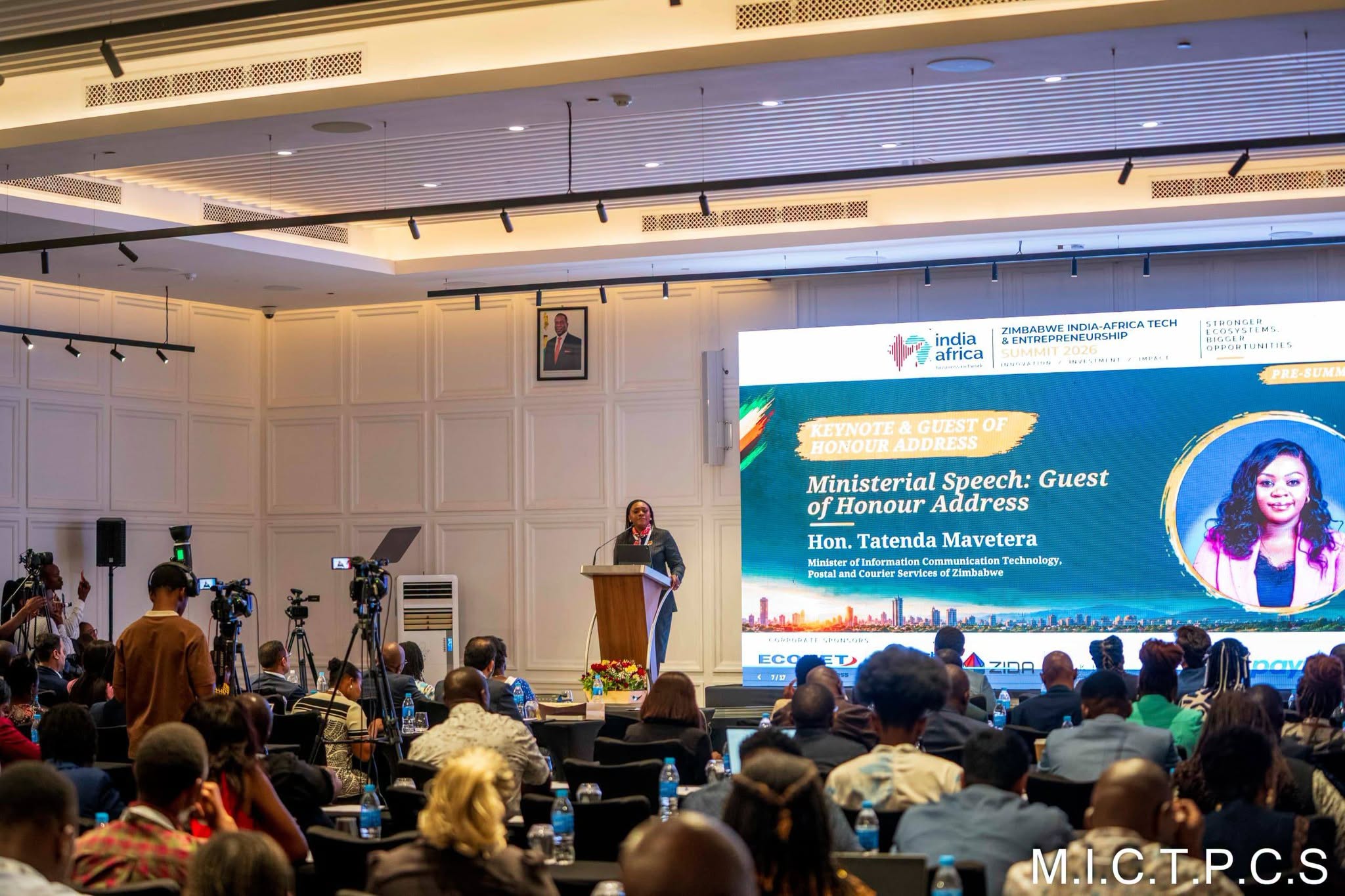
That question was at the centre of the Zimbabwe-India-Africa Tech and Entrepreneurship Summit 2026, held this week at the Hyatt Regency Hotel in Harare. Running under the theme "Building Africa's Digital Economy: Innovation, Infrastructure and Investment Partnerships", the two-day gathering brought together government, investors and technology entrepreneurs from India and Zimbabwe. It was the first country-level summit co-hosted with the India-Africa Entrepreneurship Forum, which is itself a signal that Zimbabwe is being taken seriously as a destination for technology partnerships.
The summit was attended by the Minister of Information Communication Technology, Postal and Courier Services, Hon. Dr Tatenda Mavetera, who officially opened it, and by Hon. Jenfan Muswere. It was convened with the Zimbabwe Investment and Development Agency (ZIDA) through Dr Busisa Moyo, whose role in bringing investors, policymakers and entrepreneurs into one room deserves recognition. Convening is underrated work. Partnerships rarely begin in a contract; they begin in a conversation between people who would not otherwise have met.
Technology must be judged by what it does for people.
The most useful message from the opening session was also the simplest. Minister Mavetera argued that the value of the ICT sector will be measured by its effect on livelihoods: technology must produce jobs, viable businesses and better public services. That is the right test, and it is a demanding one. It moves the conversation away from how many platforms have been launched and towards whether a young graduate has found work, whether a small business has found a customer, and whether a citizen has been served faster.
From that standard, the Minister set out priorities that, taken together, form a fair answer to the question of what it takes to build a digital economy: dependable and affordable infrastructure, talent that moves from learning into work, sustainable enterprises, responsible AI, and trust. Each deserves a closer look
1. Infrastructure that works and that people can afford
Nothing digital runs without power, connectivity and affordable access. Network coverage on a map means little if electricity is unreliable, service quality is poor or data is out of reach for ordinary households and small firms. The Minister was direct about this: coverage has to be matched by reliable power, service quality and affordability. Investment in data centres, fibre and connectivity, much of which was discussed with Indian partners, is the foundation on which everything else is built. Software companies like ours can build excellent systems, but they are only as useful as the infrastructure they run on.
2. Talent that moves from learning to work
Zimbabwe's greatest digital asset is its people. We have a young, well-educated, English-speaking workforce, and that is a genuine competitive advantage. Co-founder of the India-Africa Entrepreneurship Forum, Mr Baljinder Sharma, made the point that this population positions Zimbabwe to become a competitive business process outsourcing (BPO) destination. Indian BPO and IT services firms have decades of experience in exactly this model, and partnership with them can mean jobs and export earnings for Zimbabwe.
But talent has to be converted into employment. That means graduates who leave university with practical, employer-relevant skills, internships and apprenticeships that connect classrooms to industry, and a pipeline in which what is taught tracks what the market is buying. A degree that does not lead to work is a missed opportunity for the graduate and for the country.
3. Enterprises with paying customers
An ecosystem is not measured by how many startups pitch at an event. It is measured by how many survive, earn revenue and employ people. The Minister stressed that innovation showcases should connect startups to paying customers, and that point cannot be repeated often enough. The largest customers in any economy are government, large corporates and the financial sector. When those buyers give local firms a fair opportunity to supply them, through procurement that values local capability, a market is created that no amount of pitching can replace. Local developers need to be able to build for Zimbabwean institutions and win.
4. Responsible AI, local data and local languages
Artificial intelligence will shape the next decade of work, and countries that rely entirely on imported systems will find that those systems do not understand their people. Two ideas discussed at the summit stand out. The first is Pangolin AI, the national platform the Minister highlighted as giving local firms and researchers sovereign infrastructure to build on, with privacy and security considered from the planning stage. The second is a proposal for an AI data and language studio covering English, Shona and Ndebele. If Zimbabwean languages are well represented in the data that trains AI systems, then chatbots, voice services and public-service tools can serve citizens in the languages they actually speak. That is both an inclusion issue and an economic opportunity, with real work to be done in data collection, annotation and model development.
5. Trust
No digital economy functions without trust. People will not move their savings, their business records or their identities online if they fear fraud or abuse of their data. This is why the national conversation on cybersecurity matters just as much as the one on investment. A credible cybersecurity strategy, clear data protection practice, and fast, coordinated responses when fraud occurs are not side issues. They are what makes digital payments, e-commerce and online government services viable.
What this means for Zimbabwean businesses and builders
At Sangana Africa, we spend our days building systems that Zimbabwean institutions rely on, from levy management platforms for National Employment Councils to custom enterprise software and professional training. That experience points to a few practical lessons.
• Start from a real problem. The best digital projects begin with a bottleneck that costs people time or money, not with a technology.
• Build for integration. Banks, payment providers, regulators and accounting systems must talk to each other. Isolated systems create new silos.
• Invest in the people who run it. A system is only as good as the training and support behind it.
• Plan for local conditions. Intermittent power and connectivity, mobile-first users and cost sensitivity are design constraints, not afterthoughts.
• Partner deliberately. Partnerships with Indian and other international firms should transfer skills and create local jobs, not simply import solutions.
From conversation to delivery
Summits are valuable, but their worth is realised afterwards. The real test of the Zimbabwe-India-Africa summit will be whether the conversations become signed partnerships, whether the proposals for an anchor outsourcing partnership and an AI language studio move from discussion to delivery, and whether young Zimbabweans can point to jobs that did not exist a year ago. Government has set out a sensible agenda, and the private sector now has to match it with execution. Government, industry, academia and development partners each hold a piece of this puzzle, and none can complete it alone.
Zimbabwe has the talent, the ambition and increasingly the partners. What remains is the disciplined work of building infrastructure, skills, enterprises and trust, one project at a time. That is what it takes to build a digital economy, and Sangana Africa is ready to play its part.